

2026 Interior Design Trends: Why Expensive Remodels Look Outdated in Just One Year
Hello. I'm the space director at Kkumdam, where we add lasting value to your living spaces.
Have you ever spent $50,000 or more on a home remodel, only to move in and feel like you're living in a stranger's house?
Many homeowners copy and paste trendy designs from Pinterest or Instagram, only to find their space feeling boring and impractical just a year or two later.
This happens when you compromise due to budget constraints or chase fleeting interior trends while ignoring your own lifestyle. Today, we're going to dive deep into the 2026 interior design paradigm to help you prepare for the future of living spaces.
If you read this article to the end, you'll gain the insights needed to design a "true space" that goes beyond mere aesthetics, boosting your daily efficiency and quality of life by over 30%.
1. Why Should You Prepare for 2026 Interior Trends Now?
Many people ask, "It's not even 2026 yet, so why are we already talking about 2026 interior design?"
Unlike clothes or shoes, interior design isn't a consumable good you can swap out every season. Once built, you'll live in that space for at least 5 to 10 years.
Therefore, if you get trapped in uniform styles currently trending—like 'Mid-Century Modern' or 'All-White Minimalism'—your home will feel like an outdated outfit in just two or three years.
According to the latest reports from global space trend analysis agencies, the core keywords for interior design in 2026 are 'Hyper-Personalization' and 'Wellness'.
The era of pursuing mere visual beauty is over. Today, spaces must read the user's biological rhythm, provide psychological stability, and adapt flexibly to changing lifestyles.
To ensure your expensive remodel doesn't fail, you must focus on the essential value of space that will last into 2026 and all the way to 2030, rather than today's fleeting fads.
2. Space Changes the Brain: Neuro-architecture in Your Home
The Secret to Invisible Psychological Stability
Have you ever noticed how a specific cafe helps you focus, while entering certain rooms inexplicably leaves you feeling anxious or stifled?
This isn't just your imagination. According to research by the Academy of Neuroscience for Architecture (ANFA), ceiling height, subtle differences in lighting, and even wallpaper texture directly affect our brainwaves and cortisol (stress hormone) levels.
The 2026 interior design paradigm actively introduces this Neuro-architecture into residential spaces.
For example, a bedroom designed for rest might visually lower the ceiling slightly to create a cozy, cave-like sense of security. Conversely, a home office meant for creative work provides vertical openness to help stimulate brain activity.
When a spatial layout is tailored to its purpose, our work efficiency can soar by up to 45%, and sleep quality can improve dramatically.
3. The Core of 2026 Interiors: Invisible Tech Smart Homes
Hiding Technology, Revealing Emotion
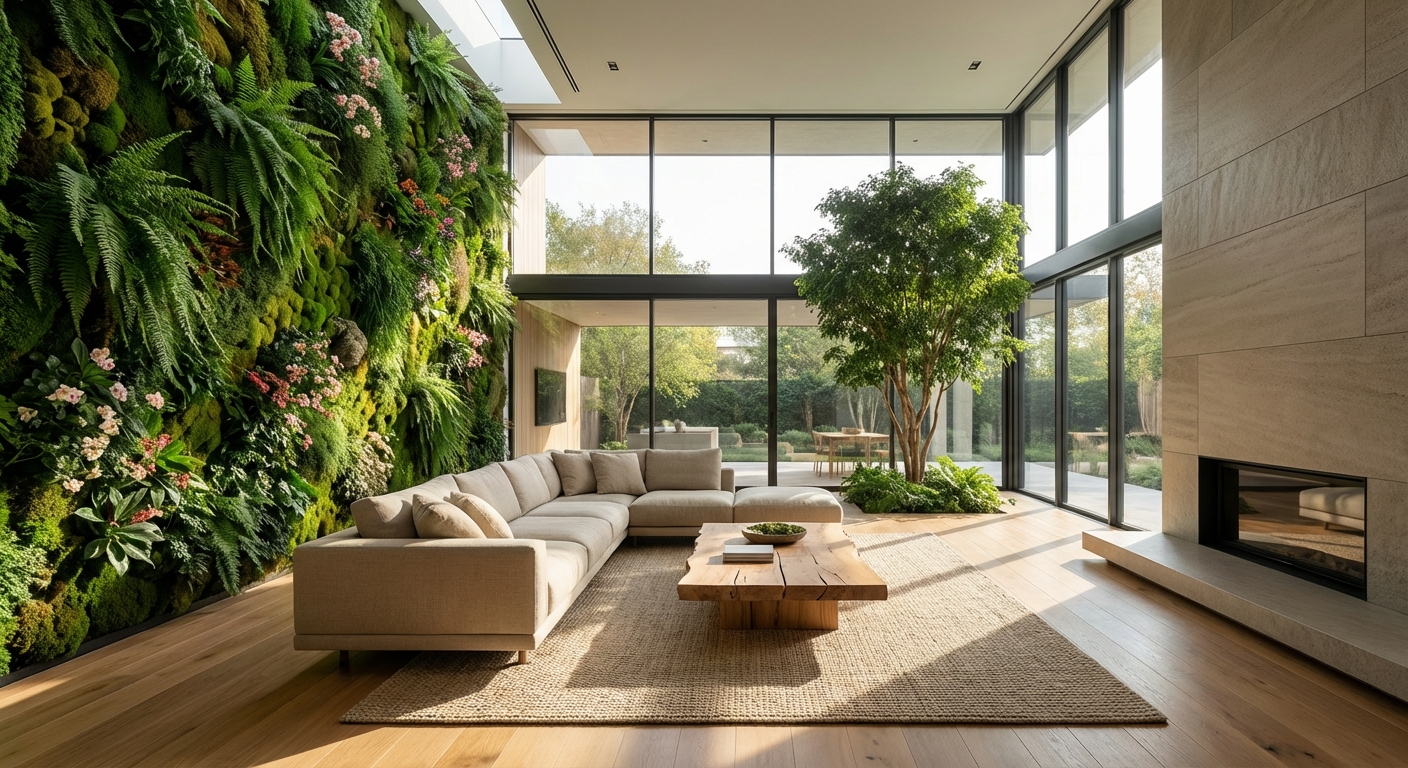
When we think of a smart home, it's easy to picture a cold environment filled with glowing panels and complex gadgets lined up everywhere.
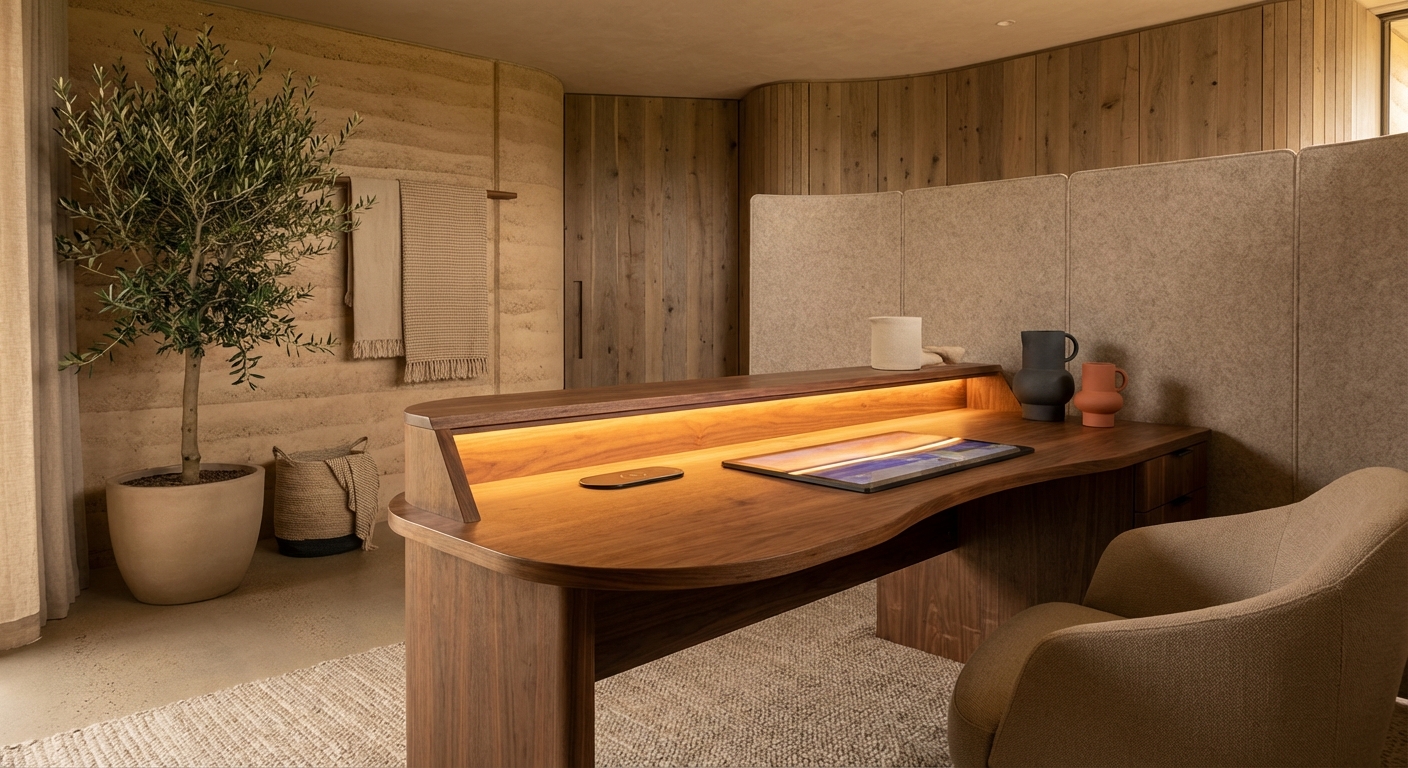
However, in true high-end 2026 interior design, technology acts like an experienced 'invisible butler,' never imposing its presence. We call this Invisible Tech.
Imagine a wall with a luxurious wood texture that, upon a light touch, gently reveals an interface allowing you to adjust the temperature and humidity.
Furthermore, speakers are flawlessly embedded within the ceiling and wall finishes, delivering concert-hall acoustics without compromising the room's aesthetics.
Appliances also go beyond simple built-ins. The key is to design them to blend perfectly with the furniture, looking like art pieces or standard cabinetry when not in use.
Drastically reducing visual noise while maximizing daily convenience—this is the ultimate union of technology and emotion that future interior design aims to achieve.
4. Evolved Nature-Friendly Design: Biophilic Design 2.0
Going Beyond Just Placing a Few Potted Plants
Since the pandemic, people have developed a strong desire to bring nature indoors.
While traditional 'planteriors' stopped at placing a few large pots in the corner of the living room or turning a balcony into a small garden, 2026 interior design is evolving into Biophilic Design 2.0.
This goes beyond visual greenery; it means structurally integrating nature's essential elements—light, wind, water, and the texture of earth—into the indoor environment.
For instance, precise calculations of the sun's path are used to alter ceiling structures or induce reflected light, drawing natural sunlight deep into the room.
Interior finishes also replace smooth, cold artificial materials with the rough, natural grain of solid wood or stone textures that mimic the feel of natural rock, maximizing visual and tactile comfort.
In fact, studies have proven that simply spending time in a space with properly applied biophilic design can reduce residents' stress levels by more than 30%.
5. Hyper-Personalized Modular Spaces and Sustainability
A Chameleon-Like Home That Adapts to Your Life Cycle
A home that was perfect for a newlywed couple often suddenly feels cramped and uncomfortable once a baby arrives.
This happens because while the space is fixed, the occupants' life cycles continue to change. That's why 2026 interior design places the utmost importance on Flexibility.
Like a bespoke suit perfectly tailored to your body, 'modular walls' and 'adaptable partitions' that allow you to change room sizes and purposes at will are becoming standard features.
A prime example is sliding away the wall that separates the living room and study to create a massive home party space, or a flooring system with built-in noise-canceling mats that can be swapped out like building blocks.
This modularization is directly linked to environmental Sustainability. It can reduce the massive amount of construction waste generated during moves or structural changes by up to 40%.
The use of Earth-conscious, ethical materials—such as vegan leather, sound-absorbing panels made from mushroom mycelium, and eco-friendly tiles crafted from recycled plastics—is no longer an option, but a necessity.
6. The Magic of Light That Turns Daily Life into Art: Circadian Lighting
Smart Lighting Design That Reads Human Biological Rhythms
You've probably heard that lighting is the finishing touch of any interior. In 2026 interior design, lighting goes beyond merely illuminating the dark; it takes on the characteristics of a health-managing medical device.
Our bodies operate on a circadian rhythm, naturally waking and resting in sync with the sun's movements.
During the day, bright, cool 6500K lighting with blue undertones boosts focus and energy. As the sun sets, the system automatically transitions to warm, soft amber lighting under 2700K, aiding melatonin production.
Moreover, the uniform method of lighting an entire room with a single large main fixture (like a recessed tray ceiling light) in the center is gradually disappearing.
Instead, the basic formula for high-end interiors is layering dozens of glare-free cove lights and task lights that can be turned on and off as needed, adding incredible depth and dimension to the space.
7. An Investment, Not an Expense: The Economics of 2026 Interiors
One Proper Remodel Cuts Maintenance Costs by 30%
By now, you might be worrying, "Won't it be too expensive to design with this level of detail?"
Of course, initial design and construction costs may be slightly higher than those of a standard turn-key contractor. However, broaden your perspective and imagine a 10-year residency.
By integrating a passive house design that maximizes insulation and airtightness with a highly efficient smart HVAC system, you can slash your monthly energy bills by 20% to 30%.
Additionally, a timeless design eliminates the need to tear out wallpaper or finishes every 3 to 4 years just because a trend has passed, dramatically lowering long-term maintenance costs.
The same applies to real estate value. A premium, wellness-based living space tailored perfectly to the occupant's lifestyle will command unrivaled market value when it comes time to sell.
8. A Checklist to Prevent a 2026 Interior Design Failure
For those who have read this far, we've compiled a 'Fail-Proof Space Planning Checklist' that you must review before signing an interior design contract.
| Checklist Item | Past Interiors (What to Avoid) | 2026 Interior Standards (What to Aim For) |
|---|---|---|
| Lighting Design | A single, massive main light in the center of the room | Dimmable indirect lighting and multiple task lights |
| Space Utilization | Fixed-purpose structures for the master bedroom, living room, and kitchen | Multi-purpose, adaptable layouts using furniture and partitions |
| Material Selection | Artificial chemical materials like vinyl wraps that only look good on the surface | Solid wood, stone, and eco-friendly materials that age gracefully over time |
| Smart Home | Devices exposed externally, creating visual clutter | Invisible tech completely concealed within the interior finishes |
| Storage Planning | Stifling cabinets awkwardly forced into empty spaces | Custom built-ins calculated down to the centimeter based on user traffic flow |
We highly recommend saving this table to your smartphone and asking contractors if they can meet these standards during your meetings.
9. Start Your Perfect 2026 Interior Journey with Kkumdam
A space isn't just a place to stay; it's the largest vessel for capturing your life's values and philosophy.
Don't waste tens of thousands of dollars of your precious budget on cookie-cutter designs or shallow trends that quickly become tiresome. You need a home meticulously calculated for your daily routines, traffic flow, and future lifestyle.
Our Kkumdam (Dreams) team goes beyond being a simple construction company. We deeply understand our clients' lives and propose optimal spatial solutions combining neuro-architecture and smart home technology.
Do you have a vague dream of a space in mind? If you want your own bespoke home that remains beautiful and practical in 2026, 2030, and beyond, contact us today.
Through a free 1:1 consultation with our space planning experts, we'll help you unlock 100% of your home's hidden potential.