
Transforming a Former Bookstore into an AI EdTech Cultural Complex: The Ultimate Guide to Reviving Large Commercial Vacancies
Are you currently absorbing massive rental losses, struggling for months to find the next tenant for tens of thousands of square feet of commercial space after a major anchor tenant like a large bookstore moved out?
In the past, massive bookstores like Bandi & Luni's served as the beating heart of commercial buildings and shopping malls, single-handedly driving foot traffic. However, with the shrinking print book market and the collapse of traditional offline retail, these vast spaces of knowledge—spanning anywhere from 18,000 to 35,000 square feet—are now being left as cold, empty vacancies.
As a commercial real estate planner and consultant, I have visited countless large-scale vacant properties. Standing in an empty bookstore, I can still feel the breathing potential of its unique, high ceilings and well-structured pedestrian flow. Simply dividing the space to fit in a few restaurants or clothing stores is not a fundamental solution. We need a new killer concept that modernly inherits the bookstore's identity as the intellectual hub of the commercial district while generating guaranteed dwell time and overwhelming profits.
The answer is an 'AI EdTech Cultural Complex'. If the bookstores of the past were places to consume completed knowledge (books), the spaces of the future must be places where people generate and experience knowledge themselves.
Today, on the Kkumdam (Dreams) blog, we will prove with numbers and data how to transform a massive space like a former bookstore into an AI education-centric cultural complex—covering everything from concrete planning theory and monetization models to a strict execution checklist.
1. Why an AI EdTech Cultural Complex in a Former Bookstore Location?
Anyone who has worked in real estate development or space planning will agree: rather than completely overturning a space's purpose, it is far more advantageous from a branding perspective to cleverly twist its existing "placeness" to give it new value.
Modern Inheritance of an Intellectual Hub
The location of a former large bookstore is already imprinted in the minds of local residents as an intellectual hub for learning, relaxation, and intellectual exploration. Parents visited the bookstore every weekend for their children's education, and professionals stopped by after work for self-improvement. An AI EdTech cultural complex precisely absorbs the search intent and visit purpose of these existing customers.
The space where people used to read paper books to grow their imagination now evolves into a creative space where they input prompts to manifest that imagination into real-world images and code. This is not the destruction of a space, but the "evolution of how knowledge is consumed."
Creating Overwhelming Dwell Time and Foot Traffic
The key metric for offline spaces is "Dwell Time." According to recent retail trend analyses, the average dwell time in a simple destination shopping mall is only 45 minutes, but the average dwell time in an "experiential EdTech space" reaches a staggering 2.5 to 3 hours.
An AI cultural complex is not limited to one-off visits. It has a powerful lock-in effect due to its educational academy aspect, requiring regular visits once or twice a week. While a child takes an AI coding or robotics class for two hours, parents can drink coffee and work in the book cafe or creator lounge within the same space. This directly translates to F&B (Food & Beverage) sales and space rental revenue.
In fact, commercial facilities that have introduced similar EdTech complexes have proven a definite trickle-down effect: weekend foot traffic for the entire building increased by over 40% compared to before the introduction, and the sales of connected surrounding stores (F&B, retail) rose simultaneously.
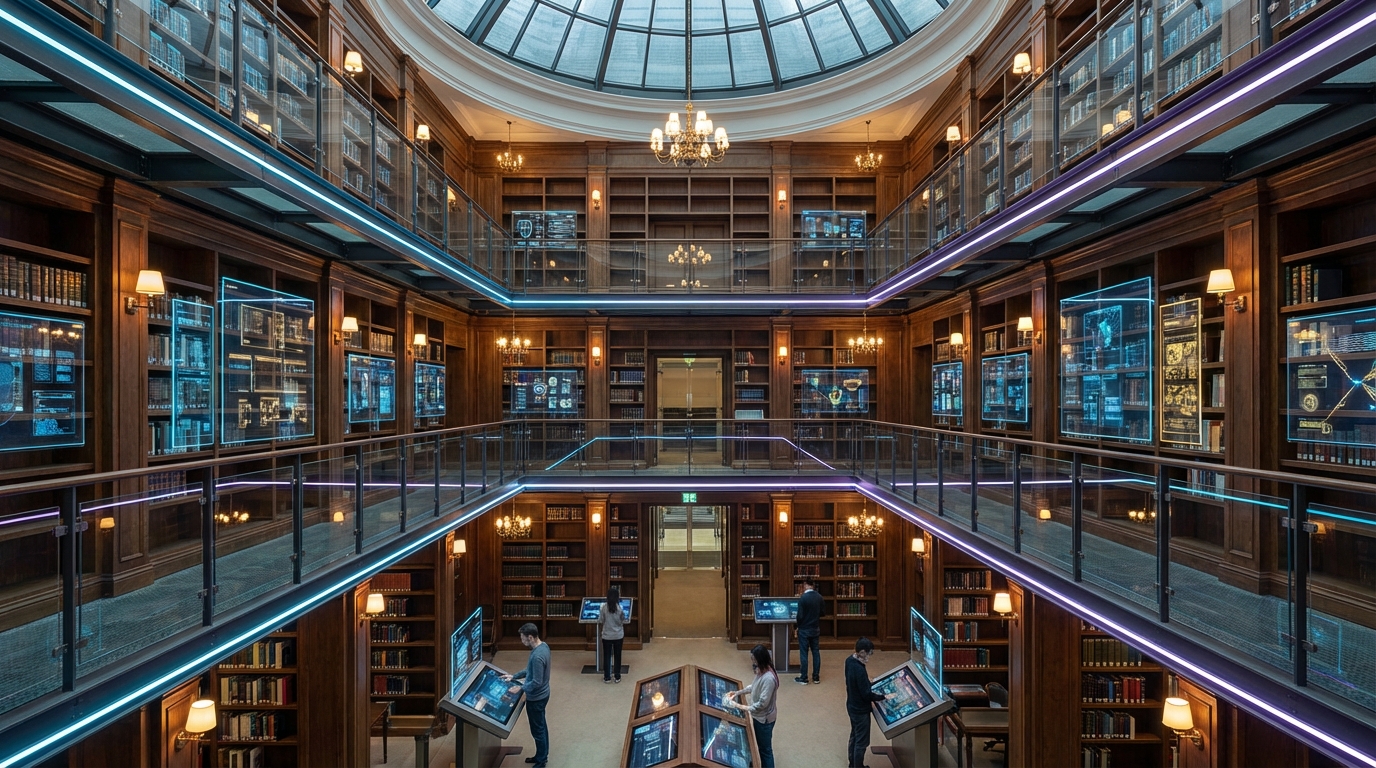
2. How to Fill an 18,000 Sq Ft Vacancy with AI (Space Zoning Strategy)
Looking at the vast floor plan of a massive former bookstore can be overwhelming. A successful cultural complex starts with thorough "Zoning." We recommend designing the space into the following four core zones so that customers naturally permeate the space following the flow of movement.
Zone A: Prompt Library & AI Exhibition (Attraction and Inspiration)
This is the entrance area where the traditional bookstore's bestseller stands used to be. Here, you need a flashy visual hook to stop passersby in their tracks. Instead of paper books, place giant transparent OLED displays and interactive media art.
This is a gallery where outstanding AI prompts generated by experts and their results (artwork, novels, music) are exhibited. Anyone can use the provided tablets to combine simple words and display their own AI creations on the screen. It is a fusion of analog and digital that maintains the interior design of a bookstore's bookshelves, but what is shelved are not books, but "digital prompt cards."
Zone B: Generative AI Creation Lab (Core Revenue Generation - Education)
This is the heart of the space and the zone that generates the highest revenue. Build multiple state-of-the-art lab rooms partitioned by transparent glass walls. Operate specialized programs tailored to target ages and purposes.
- Kids AI Lab: Play-centric education such as building robots that combine LEGO and AI vision, or writing English children's books directly using ChatGPT.
- Adult/Professional Lab: Practical design classes using Midjourney, Python-based data analysis, and workflow efficiency seminars using AI automation tools (like Zapier).
- Senior Smart Lab: Lifestyle-integrated education, such as how to use AI assistants for the digitally marginalized and AI for voice phishing prevention.
Fully equipped with top-tier workstations and GPU cloud environments, this space runs seamlessly every weekday evening and throughout the weekend, becoming a relentless source of revenue.
Zone C: Co-working & Book Cafe Lounge (Maximizing Dwell Time)
This is an F&B fusion space for general visitors not taking classes or parents waiting for their children. The quiet cafe inside the old bookstore is now transformed into an open co-working space.
It doesn't just sell coffee. Every seat provides high-speed charging ports and gigabit Wi-Fi, and the latest tech and IT-related books (the only space where paper books remain) are curated and displayed. By introducing a monthly membership system, it takes on the role of "our neighborhood digital headquarters" where freelancers and solo creators can work comfortably.
Zone D: Makers Studio (Materializing Experiences)
This is a space where digital results created by AI are extracted into physical reality. Equip it with 3D printers, laser cutters, and large plotter printers. A child can 3D-print a monster character they drew with AI into a figurine to take home, or an adult can print a pattern they designed onto an eco-bag. It is the ultimate "Phygital" experience where the digital world meets the physical.
3. Proving the Investment Value and Revenue Model of an AI Space with Numbers
No matter how great the space planning is, business must be proven with numbers. How can you recover the massive initial interior and hardware setup costs, alongside the steep rent of a large commercial space? The core of this business lies in the diversification of revenue pipelines.
| Revenue Category | Details | Expected Revenue Share |
|---|---|---|
| Academy / Education | Regular AI curriculum tuition fees for kids and adults (monthly payments) | 45% |
| F&B (Food & Beverage) | Book cafe lounge coffee, bakery, and space rental revenue | 25% |
| B2B Rentals / Seminars | Corporate workshops, product launches, hackathon event venue rentals | 15% |
| Membership / Retail | Lounge monthly subscriptions, Makers Studio merch sales | 15% |
In the past, bookstores relied solely on a single revenue model of "book sales margins," which made it inevitable for them to collapse under the fierce competition of Amazon and online retailers. However, an AI EdTech cultural complex sells physical experiences, which cannot be replaced online.
For example, when operating an 18,000 sq ft space, securing just 300 students a day on weekends (at an average ticket price of $40) generates over $110,000 in average monthly education revenue alone. Add to this the parents' F&B consumption and weekday corporate workshop rentals (spaces fully equipped with large screens and the latest gear have explosive B2B rental demand), and you can cut annual operating costs by 30% while achieving operating margins more than twice as high as traditional retail stores.
This is not a mere assumption. Global real estate consulting firms are upgrading the value of "experiential EdTech tenants" in shopping malls to Tier-1 anchor tenants, evaluating them as key drivers for property value-add.

4. 3 Essential Weapons You Must Not Miss When Planning an Offline AI Space
Approaching this with standard commercial interior design methods is a recipe for failure. This is a specialized space where IT infrastructure and community intersect. The following three elements must be considered from the initial design phase.
First, Invisible Infrastructure: Powerful Networks and Cooling Systems
Dozens or hundreds of devices must simultaneously run heavy cloud-based AI models (image generation, video rendering, etc.). Standard commercial internet networks cannot handle this bandwidth. Establishing a dedicated enterprise line is mandatory, and enterprise-grade network equipment is required to distribute traffic seamlessly to each lab room.
Furthermore, the HVAC (heating, ventilation, and air conditioning) design must be completely re-engineered to handle the heat generated by multiple workstations. Comfort directly translates to the quality of learning and dwell time. You must boldly invest your initial budget in the server room, wiring, and cooling systems rather than just visual aesthetics.
Second, Software Beats Hardware: Relentless Content Curation
AI technology pours out new tools every week. If you build a beautiful space once and repeat past curriculums, you will quickly fall behind. The space operator must become an excellent "AI Curator."
You need to select and exhibit the "AI Tool of the Month" and update your curriculum accordingly. For example, during the week a new model from OpenAI is announced, you should immediately hold a related free pop-up seminar to focus the local community's attention. The physical space is fixed, but the software filling it must constantly change like flowing water to keep customers coming back.
Third, A Space of Connection: Local Community Building
Ultimately, the vitality of a space is created by people. On a weekend evening, try opening the lab room partitions to create one giant Hackathon arena. Host events where local university students and professionals gather, eat pizza all night, and solve real-world problems using AI.
For kids, hold a quarterly "AI Creative Awards" and prominently display their artwork in the space's gallery. The whole family—parents and grandparents—will visit to take pictures, which becomes the most reliable viral marketing source for local parenting forums and community groups.
5. Execution Guide & Foolproof Space Setup Checklist
Reading this, you probably thought about applying it immediately to a building you own or a space you are planning. Here are the action items you need to start tomorrow to turn this idea into reality.
- Step 1: Trade Area & Target Data Analysis
- First, extract data on the school-age population within a 3-mile radius, the percentage of millennials and Gen X, and the distribution of nearby schools and tutoring academies. (The ratio of lab rooms will change depending on whether your target is children or professionals.) - Step 2: Check Physical Space Limitations
- Consult an expert to diagnose how much electrical capacity can be upgraded, whether a separate space for a server room can be allocated, and what the scope of demolition and restoration of the existing bookstore entails. - Step 3: Build EdTech Partnerships
- A landlord cannot create all the AI curriculums from scratch. Form "space provision + revenue share" partnerships with startups or instructors who already possess proven educational content. - Step 4: Marketing and Pre-opening
- One month before the grand opening, invite local influencers and teachers to host a free AI trial event. Catch operational bugs using the feedback generated and spread positive experiences across social media.
* Tip: Before simply calling a contractor or interior design firm, decide what "software (content)" will be placed in the space first, and then design the vessel (interior) that fits it to prevent redundant investments.
6. Transform Your Space Successfully with Kkumdam
A massive empty space is a crisis, but if properly directed, it is a tremendous opportunity to leap forward as the region's top landmark. Just as large bookstores symbolized the intellect of an area in the past, your vacant space can be reborn as a sanctuary of digital intellect for future generations.
However, handling everything from complex IT infrastructure setup to the latest AI education curriculum settings and F&B circulation planning is almost impossible for a landlord or planner to manage alone. Chasing trends often ends with superficial interior decoration and poor execution.
Kkumdam (Dreams) is not a simple interior design company. We are a space creative partner that provides a perfect integrated solution—from planning and content sourcing to hardware setup and marketing operations—so that your space can generate its own revenue and continuously lead trends.
Are you currently worrying over a massive, empty commercial space? Stop throwing expensive rent into thin air. The space experts and AI education planners at Kkumdam will visit your site in person and provide customized space planning consulting optimized for your commercial district.
Curious about the ROI of an AI cultural complex perfectly tailored to your building?
Apply for a free on-site diagnosis and consultation from the Kkumdam team today. We will breathe the most tangible life into your space.
Apply for Kkumdam's Free Space Consulting